
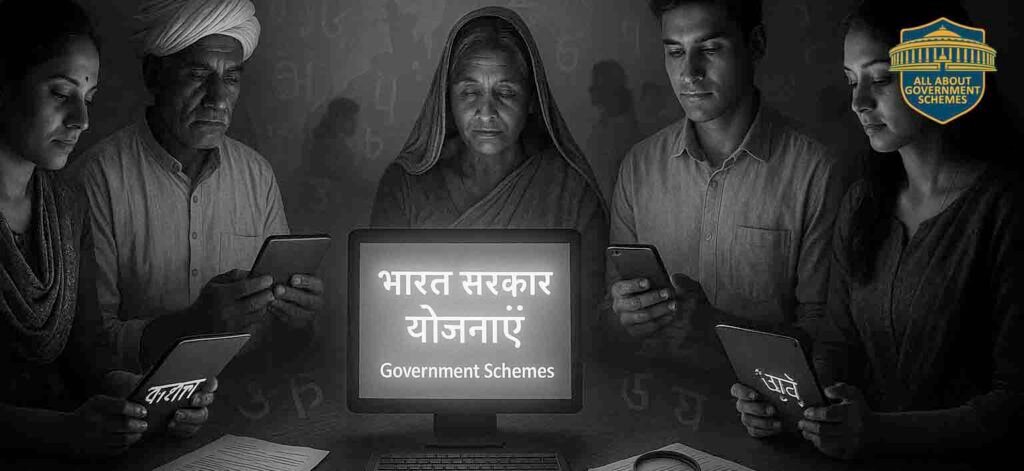
India doesn’t speak with one tongue — it sings in many.
From the soft rhythm of Malayalam in Kerala to the confident cadence of Punjabi in Punjab, every language carries stories, emotions, and traditions.
But for years, government information was mostly written in one dialect — bureaucratese.
Citizens often struggled not because schemes didn’t exist, but because they couldn’t understand them.
At All About Government Schemes, we believe information is a right — and rights should never get lost in translation.
That’s why we bring every major scheme, guide, and application process to you in your own language — English, Hindi, Tamil, Telugu, Bengali, Marathi, Urdu, Kannada, Gujarati, Malayalam, and more.
Because empowerment begins when information feels familiar.
Why Language Matters
Language is not just a medium; it’s identity.
When citizens read in their mother tongue, they don’t just comprehend — they connect.
Government portals often default to English or Hindi, but 70 % of India’s population prefers regional languages for day-to-day communication.
That means millions of potential beneficiaries remain excluded from understanding benefits they deserve.
Think of it this way:
| If the scheme is in… | Many citizens feel… |
|---|---|
| English legal format | Intimidated or unsure |
| Hindi only | Disconnected in southern & eastern regions |
| Local language | Confident, included, respected |
Our mission is simple — to make every government scheme understandable to every Indian.
We translate not just words, but contexts — ensuring accuracy, cultural relevance, and ease.
So when a farmer from Telangana reads about PM-KISAN in Telugu, or a mother in West Bengal learns about Matru Vandana Yojana in Bengali, they don’t feel like outsiders to governance — they feel like participants.
We believe inclusivity starts with comprehension.
How We Translate: Accuracy + Emotion
Translation at All About Government Schemes is a layered process combining linguistic precision with human empathy.
1️⃣ Native-Language Experts
Our translators are not machines — they are native speakers, community teachers, and volunteers who understand both grammar and ground reality.
2️⃣ Policy + People Understanding
Every translator studies the scheme first, so meaning isn’t lost in literal conversion.
For instance, the word “beneficiary” becomes “लाभार्थी” in Hindi or “లబ్ధిదారు” in Telugu — maintaining both the technical and emotional essence.
3️⃣ AI-Assisted Consistency
We use multilingual AI tools for version control, ensuring uniform terminology across 20+ languages — so “eligibility,” “documents,” and “how to apply” always read clearly.
4️⃣ Cultural Adaptation
A translation must sound like home.
So “apply online” in Tamil reads naturally as “ஆன்லைனில் விண்ணப்பிக்கவும்”, not a stiff transliteration.
Languages We Currently Offer
| Language | Region / User Base | Platform Availability |
|---|---|---|
| English | Pan-India | Default language |
| Hindi | North & Central India | Full coverage |
| Tamil | Tamil Nadu, Sri Lanka diaspora | Full coverage |
| Telugu | Andhra Pradesh, Telangana | Full coverage |
| Bengali | West Bengal, Tripura | Full coverage |
| Urdu | Across India | Full coverage |
| Marathi | Maharashtra | Partial, expanding |
| Gujarati | Gujarat | Partial |
| Kannada | Karnataka | Partial |
| Malayalam | Kerala | Partial |
| Punjabi | Punjab | In development |
| Assamese | Northeast | In development |
Real Stories: Impact of Understanding
🧕 Razia Begum – Urdu translation changed her life
Razia from Lucknow had never applied for any government aid because forms were in English.
When she found our Urdu version of PM Ujjwala Yojana, she understood eligibility instantly and applied within a day.
“I didn’t need help from anyone,” she smiles. “I understood it myself.”
👩🌾 Nagaratna – Reading PM-KISAN in Kannada
A small farmer from Mandya, she said:
“When the scheme came in Kannada on my phone, I finally believed it was meant for me.”
🧑🎓 Rakesh – Student from Assam
He used the Assamese translation of the National Scholarship Portal guide to fill his form correctly — no agent, no fee.
Each of these voices proves that language is the first step to independence.
Our Promise of Accuracy
We ensure translations are verified line-by-line against the original government text.
Any ambiguity is checked with:
- Ministry’s official scheme PDF.
- Press Information Bureau (PIB) releases.
- State-specific circulars.
This triple-layer process guarantees that our multilingual pages remain both authentic and empathetic.
The Technology Behind Multilingual Access
We’ve integrated an advanced translation pipeline powered by AI + human review, featuring:
- Real-time updates: Whenever the English version changes, translators receive automated alerts.
- Parallel text databases ensuring identical structure across languages.
- Accessibility compliance: Font readability, right-to-left layout for Urdu, and screen-reader support.
This infrastructure turns translation into digital inclusion at scale.
Why Governments Support Multilingual Awareness
India’s ministries now encourage localization because it increases citizen participation.
For instance:
- The Digital India Portal is multilingual.
- MyGov publishes blogs in nine languages.
- Aadhaar and UMANG support regional versions.
Our initiative complements these efforts, making verified content citizen-ready in every dialect.
The Vision: Language + Literacy + Access
The real goal isn’t just translation — it’s transformation.
We envision an India where:
✅ Every citizen can read their rights.
✅ Every scheme has a voice in every language.
✅ Every official announcement reaches people directly.
This is the foundation of Digital Democracy — one that listens in every tongue.
Challenges Ahead
Language inclusion isn’t easy. We face:
- Shortage of skilled translators for smaller languages.
- Regional variations (Bhojpuri vs Maithili, Kannada vs Tulu).
- Technical encoding issues (fonts, Unicode).
But with every obstacle we overcome, one more citizen feels seen and heard.
“True inclusion is not just building ramps for access — it’s building bridges of understanding.”
Our Roadmap
1️⃣ Full coverage of 22 Indian languages by 2026.
2️⃣ Voice-based narration for visually impaired users.
3️⃣ Community Translation Network inviting volunteers.
4️⃣ Multilingual YouTube explainers for rural audiences.
5️⃣ Regional social-media handles (Tamil, Bengali, Urdu).
Because when citizens speak to governance in their language, democracy becomes dialogue, not monologue.
Conclusion
A nation of 1.4 billion cannot be served by one script alone.
When a grandmother in rural Odisha can understand pension forms in Odia, or a youth in Kashmir can read employment programs in Urdu, empowerment becomes personal.
At All About Government Schemes, we’re not just translating text — we’re translating trust.
Every word we publish, in every language, carries one message:
“You belong here. The government works for you — in your words, your way.”
MultilingualIndia #AccessibilityForAll #DigitalInclusion #CitizenAwareness #PublicWelfare #LanguageEquality #InclusiveGrowth #SmartGovernance #RegionalVoices #AllAboutGovernmentSchemes