
Important: This is not an official government website. Always verify details on official government portals before applying.
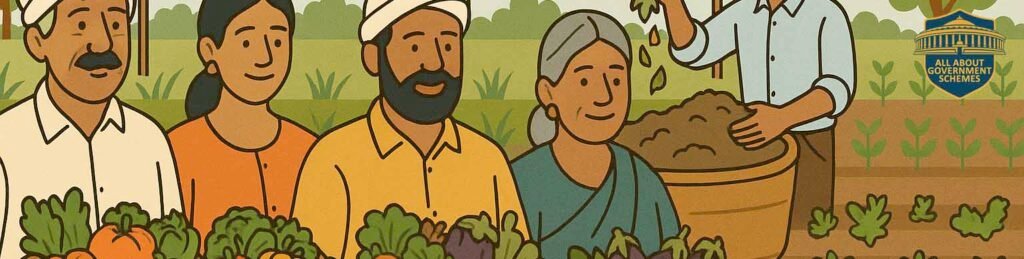
Paramparagat Krishi Vikas Yojana (PKVY)
Ministry: Ministry of Agriculture & Farmers Welfare, Government of India
Launched: 2015–16 (as a sub-scheme under the National Mission on Sustainable Agriculture – NMSA)
Implemented By: Department of Agriculture, Cooperation & Farmers Welfare (DAC&FW)
Scheme Type: Organic Farming & Sustainable Agriculture
Beneficiary Type: Farmers, Farmer Producer Organizations (FPOs), Cooperatives, Clusters
Coverage: All States & Union Territories
Category: Agriculture & Farmers Welfare
Official Website: https://pgsindia-ncof.gov.in
About the Scheme
The Paramparagat Krishi Vikas Yojana (PKVY) is a flagship initiative to promote organic farming through cluster-based and participatory certification approaches.
It encourages farmers to adopt eco-friendly, traditional, and chemical-free methods of cultivation while ensuring better returns through organic produce markets.
Goal: To make agriculture sustainable, reduce dependence on chemical fertilizers and pesticides, and increase soil fertility and farm income through organic farming practices.
🧭 Objectives
- To promote cluster-based organic farming for efficiency and scalability.
- To support farmers in organic input production, including bio-fertilizers and compost units.
- To reduce input costs and enhance farm income.
- To ensure certification and branding of organic produce under Participatory Guarantee System (PGS-India).
- To create market linkages for organic farmers.
- To promote value addition and packaging for organic products.
🧾 Key Features
- Formation of 50 or more farmers per cluster covering 50 acres of contiguous farmland.
- Each farmer receives financial assistance of ₹50,000 per hectare for three years for:
- Organic inputs (bio-fertilizers, compost, vermi-units)
- PGS certification
- Packing, branding, and marketing support
- Implementation through State Governments and Regional Councils.
- Participatory Guarantee System (PGS) certification ensures trust-based quality verification.
- Emphasis on traditional knowledge + modern organic techniques (e.g., crop rotation, green manuring, natural pest control).
- Digital monitoring through the PGS-India portal.
Eligibility Criteria
| Eligible Beneficiaries | Details |
|---|---|
| Individual farmers | Must join a cluster of minimum 50 farmers |
| FPOs / Cooperatives / NGOs | Must operate within a cluster framework |
| Area of Operation | Minimum 50 acres of contiguous land |
| Participation | Farmers must agree to follow organic standards for 3 years |
Not Eligible:
- Farmers already certified under other organic schemes (like MOVCDNER).
- Those using synthetic chemicals or fertilizers during conversion period.
Documents Required
| Type | Documents |
|---|---|
| Identity Proof | Aadhaar card / Voter ID |
| Land Ownership | Land record / lease deed |
| Bank Details | Passbook / account number |
| Group Details | Cluster formation list / FPO registration |
| Photograph | Passport-sized photo of farmer / group |
| Declaration | Consent to adopt organic farming practices |
How to Apply
🖥️ Online Method
- Visit https://pgsindia-ncof.gov.in
- Click on “Farmer Registration” under PGS-India.
- Enter personal and cluster details (village, district, state).
- Submit required documents (land record, ID proof).
- The Regional Council verifies and activates the cluster on the portal.
- Farmers are linked with organic certification and training schedules.
Offline Method
- Visit the District Agriculture Office / Krishi Vigyan Kendra (KVK).
- Fill the PKVY application form with cluster details.
- Submit it with the list of participating farmers and land details.
- After verification, the cluster will be enrolled for certification and financial support.
Implementation Cycle
| Year | Focus Area | Support Activity |
|---|---|---|
| Year 1 | Adoption | Training, soil health management, input preparation |
| Year 2 | Certification | PGS inspection, organic input use, mid-term evaluation |
| Year 3 | Marketing | Branding, packaging, participation in organic fairs |
Funds are transferred directly to farmers’ bank accounts via DBT.
Benefits
- Reduces input cost by up to 30–50%.
- Increases soil fertility and biodiversity.
- Helps farmers earn a premium price (20–25% higher) for organic produce.
- Strengthens FPOs and cooperative models.
- Creates export opportunities through certified organic produce.
📞 Contact Details
National Centre of Organic Farming (NCOF)
Department of Agriculture, Cooperation & Farmers Welfare
CGO Complex, Kamla Nehru Nagar, Ghaziabad (U.P.) – 201002
📞 Helpline: 1800-180-1551
🌐 https://pgsindia-ncof.gov.in
How to Check Status
- Visit https://pgsindia-ncof.gov.in
- Go to “Farmer Search” under PGS-India.
- Enter your Farmer ID / Cluster Code / District Name.
- View details of certification stage, verification, and validity.
Follow-Up & Grievance Redressal
- Contact your District Agriculture Officer or Regional Council Coordinator.
- Lodge grievances at: https://pgportal.gov.in
- Call National Centre of Organic Farming (NCOF) helpline: 📞 1800-180-1551
- You can also approach State Nodal Officer (Organic Farming) for assistance.
Who’s Who
| Designation | Name | Role |
|---|---|---|
| Union Minister of Agriculture & Farmers Welfare | Shri Shivraj Singh Chouhan | Oversees organic mission implementation |
| Minister of State (Agriculture) | Shri Bhagirath Choudhary | Promotes PKVY awareness & outreach |
| Secretary (Agriculture & Farmers Welfare) | Shri Devesh Chaturvedi, IAS | Administrative & policy oversight |
| DG, ICAR | Dr. Himanshu Pathak | Technical support in organic research |
| Director, NCOF | — | Nodal officer for PKVY operations |
FAQs
1. What is the duration of support under PKVY?
Farmers receive support for three consecutive years.
2. Is certification mandatory?
Yes, through Participatory Guarantee System (PGS-India) certification process.
3. Can individual farmers apply without a cluster?
No. Only farmers under a minimum 50-member cluster can participate.
4. What kind of inputs are promoted under PKVY?
Compost, green manure, bio-fertilizers, neem cake, and organic pest repellents.
5. Is the scheme open for women farmers and SHGs?
Yes, SHGs and women-led clusters are given preference.
Found outdated or wrong information?
Tell the editorial team so this scheme can be rechecked against official sources.
Report Wrong Information