
- About
- Programs & Activities
- Initiatives
- Key Achievements
- Collaboration & Linkages
- Funding & Administration
- Who’s Who
- Publications & Databases
- Digital & Institutional Linkages
- Benefits
- Contact
- Contact
- Achievements
Rashtriya Ayurveda Vidyapeeth (RAV)
Parent Ministry: Ministry of AYUSH, Government of India
Headquarters: Dhanwantri Bhawan, Road No. 66, Punjabi Bagh (West), New Delhi – 110026
Official Website: https://ravdelhi.nic.in
What Is Rashtriya Ayurveda Vidyapeeth (RAV)?
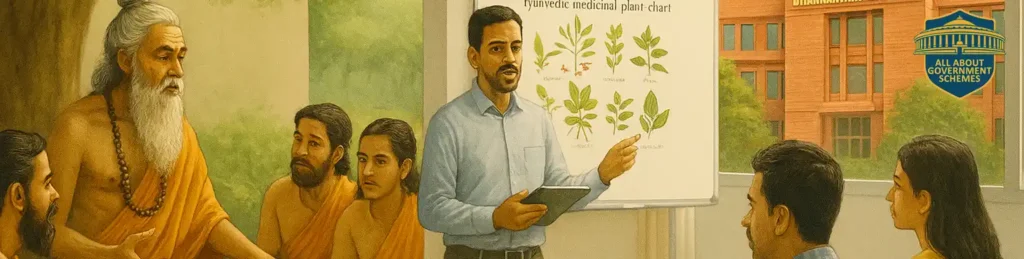
The Rashtriya Ayurveda Vidyapeeth (RAV) is an autonomous organization under the Ministry of AYUSH dedicated to reviving and strengthening the ancient Gurukul tradition of Ayurveda learning through a Guru–Shishya Parampara (teacher–disciple system) blended with modern scientific knowledge.
It functions as a national academy for higher learning, continuing education, and skill enhancement in Ayurveda — training students, teachers, and practitioners in authentic and evidence-based Ayurvedic practice.
In simple words —
RAV is where traditional Ayurveda meets modern learning — preserving classical wisdom while promoting global relevance.
Objectives
| Goal | Description |
|---|---|
| Revive Traditional Education | Promote the Guru–Shishya method of learning in Ayurveda. |
| Enhance Professional Skills | Train teachers and practitioners in clinical and classical areas. |
| Global Awareness | Spread authentic Ayurveda education globally. |
| Research & Documentation | Collect, document, and validate classical Ayurvedic knowledge. |
| Digital Education | Develop online and blended learning programs for wider access. |
Key Programs & Activities
| Program | Description |
|---|---|
| Guru–Shishya Parampara Program | One-year fellowship program where students learn directly from eminent Vaidyas (Ayurvedic masters). |
| Continuing Medical Education (CME) | Regular refresher courses for teachers and practitioners. |
| Workshops & Seminars | Specialized training on Panchakarma, Rasa Shastra, Marma Chikitsa, etc. |
| Interactive Lectures & Clinical Demonstrations | Conducted by senior Gurus in hospitals and RAV premises. |
| Collaborative Training with National Institutes | Joint programs with AIIA, NIA, and CCRAS institutes. |
| Digital e-Learning Programs | Online Ayurveda courses and webinars for global learners. |
Signature Program — Guru–Shishya Parampara
The hallmark of RAV’s work is its Guru–Shishya Parampara Program, designed to preserve authentic Ayurvedic wisdom.
Under this initiative:
- Selected postgraduate scholars (Shishyas) are trained by eminent Gurus in clinical, pharmaceutical, or theoretical fields.
- Each training lasts one academic year, with continuous practical exposure.
- The program emphasizes personal mentorship, classical text interpretation, and real-case learning.
- Participants receive a certificate recognized by the Ministry of AYUSH.
This approach ensures that classical knowledge is not lost but passed on to the next generation of Ayurvedic physicians.
Educational & Training Initiatives
| Category | Program Details |
|---|---|
| Teacher Training | CME and orientation programs for Ayurveda faculty members. |
| Student Training | Special workshops for UG and PG students. |
| Practitioner Support | Short-term courses for clinical practitioners to upgrade skills. |
| Research Orientation | Seminars on Ayurvedic research methodologies. |
| Public Awareness | Health talks and wellness sessions for general citizens. |
Key Achievements
Over 450 Gurus and 1,200 Shishyas trained under Guru–Shishya Parampara.
Conducted 500+ CME programs across India.
Launched online Ayurveda lectures attended by international participants.
Developed training manuals and textbooks on Panchakarma, Rasayana, and Dravyaguna.
Published Ayurveda research journals and monographs.
Collaborated with CCRAS, AIIA, and WHO GCTM for capacity building.
Collaboration & Linkages
| Partner Organization | Collaboration Focus |
|---|---|
| CCRAS | Research, training, and clinical validation. |
| AIIA (All India Institute of Ayurveda) | Joint workshops and teaching programs. |
| NIA (Jaipur) | Curriculum enhancement and faculty exchange. |
| WHO-GCTM (Jamnagar) | Development of global Ayurveda education modules. |
| State AYUSH Directorates | Regional CMEs and awareness programs. |
| Universities & Ayurveda Colleges | Support for faculty training and skill development. |
Funding & Governance
- Funded under Central Sector Scheme of the Ministry of AYUSH.
- Governed by a Governing Body and Standing Finance Committee chaired by the Secretary, Ministry of AYUSH.
- Day-to-day operations managed by the Director of RAV.
- Programmatic divisions include:
- Training & Education
- Guru–Shishya Fellowship
- CME & Outreach
- Publications & Documentation
Who’s Who (Leadership & Coordination)
| Designation | Officer Name | Role |
|---|---|---|
| Chairperson | Vaidya Rajesh Kotecha (Secretary, Ministry of AYUSH) | Policy oversight and strategic guidance. |
| Director, RAV | Dr. Abhimanyu Kumar (current, 2025) | Overall management, planning, and coordination. |
| Joint Director | — | Implementation of training and fellowship programs. |
| Administrative Officer | — | Finance and HR operations. |
Publications
- Proceedings of Guru–Shishya Programs
- Ayurveda Teaching Manuals (Vol. I–III)
- Compendium of RAV Workshops and CMEs
- Training Modules for Ayurveda Teachers
- Quarterly Journal “Ayurveda Sandesh”
- Reports on Ayurveda Research & Pedagogy
Digital & Institutional Linkages
| Platform | Role |
|---|---|
| AYUSH Research Portal | Repository of RAV’s educational and training activities. |
| AYUSH e-Learning Portal | Online CME and short-term Ayurveda courses. |
| AYUSH GRID | Integration of training data with other national institutes. |
| National AYUSH Mission (NAM) | Funding and support for regional training programs. |
| WHO-GCTM (Jamnagar) | Development of international learning frameworks. |
Benefits to Citizens & Stakeholders
| Beneficiary | Benefit |
|---|---|
| Students & Scholars | Advanced learning through Guru–Shishya training. |
| Teachers | CME programs for skill enhancement. |
| Practitioners | Access to authentic Ayurvedic methods and clinical updates. |
| Researchers | Exposure to classical texts and applied Ayurveda. |
| Citizens | Awareness programs on preventive and holistic health. |
Contact & Grievance Redressal
Rashtriya Ayurveda Vidyapeeth (RAV)
📍 Dhanwantri Bhawan, Road No. 66, Punjabi Bagh (West), New Delhi – 110026
📧 Email: director-rav@gov.in / info@ravdelhi.nic.in
📞 Phone: 011-25228548 / 011-25229753
🌐 Website: https://ravdelhi.nic.in
Grievances:
https://pgportal.gov.in → Ministry of AYUSH → Rashtriya Ayurveda Vidyapeeth (RAV)
Useful Links
- Ministry of AYUSH: https://ayush.gov.in
- AYUSH e-Learning: https://elearn.ayush.gov.in
- AYUSH Research Portal: https://ayushportal.nic.in
- AIIA: https://aiia.gov.in
- NIA Jaipur: https://nia.nic.in
Contact & Grievance Redressal
Central Council for Research in Yoga and Naturopathy (CCRYN)
📍 61–65, Institutional Area, Janakpuri, New Delhi – 110058
📧 Email: director.ccryn@gmail.com / info@ccryn.gov.in
📞 Helpline: 011-28520430 / 011-28522212
🌐 Website: https://ccryn.gov.in
Grievances:
🖥️ https://pgportal.gov.in → Ministry of AYUSH → CCRYN (Yoga & Naturopathy Research Council)
🔗 16. Useful Links
- Ministry of AYUSH: https://ayush.gov.in
- National AYUSH Mission (NAM): https://namayush.gov.in
- AYUSH Research Portal: https://ayushportal.nic.in
- WHO GCTM (Jamnagar): https://who.int/traditional-medicine-centre
- MDNIY: https://yogamdniy.nic.in
Achievements Snapshot
Over 1,200 Ayurvedic scholars trained in traditional methods.
Conducted CME programs in 25 states and UTs.
Developed Ayurveda Teaching Modules adopted by universities.
Collaborated with WHO and AYUSH GRID for e-learning initiatives.
Digitized classical Ayurvedic manuscripts for global access.
Social & Academic Impact
- Revives authentic Guru–Shishya learning in modern context.
- Builds highly skilled Ayurveda teachers and clinicians.
- Promotes standardized education and practice across India.
- Strengthens India’s soft power and traditional knowledge system globally.