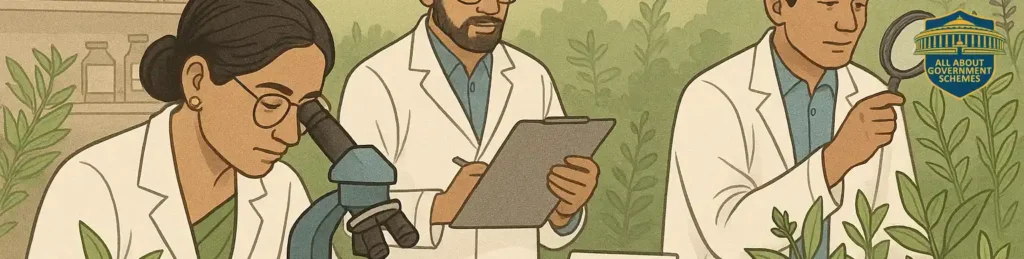
Raw Material Research – CCRAS Focus The Central Council for Research in Ayurvedic Sciences (CCRAS), headquartered in New Delhi, is the apex organization under…
VerifyCheck eligibilityApply officially
October 28, 2025allaboutgovschemes@gmail.com
Raw Material Research – CCRAS Focus
The Central Council for Research in Ayurvedic Sciences (CCRAS), headquartered in New Delhi, is the apex organization under the Ministry of AYUSH responsible for:
Sourcing, authenticating, and standardizing medicinal herbs.
Establishing pharmacognostic, phytochemical, and pharmacological parameters.
Supporting the development of Pharmacopoeial Standards for the Ayurvedic Pharmacopoeia of India (API).
This ensures that all raw materials used in Ayurvedic formulations are safe, genuine, and consistent in quality.
1. Objectives of Raw Material Research (CCRAS)
Authentication: Identify and confirm the correct botanical species of medicinal herbs used in classical Ayurvedic formulations.
Standardization: Develop scientific parameters to ensure consistent quality of raw materials.
Conservation & Cultivation: Promote sustainable sourcing through Good Agricultural and Collection Practices (GACP).
Documentation: Create a national database of raw drug specimens and their quality parameters.
Collaboration: Support the Pharmacopoeia Commission for Indian Medicine & Homoeopathy (PCIM&H) in monograph preparation for inclusion in the Ayurvedic Pharmacopoeia of India.
🔬 2. Research Areas Covered
A. Sourcing of Medicinal Herbs
Conducting field surveys across India to identify geographical regions rich in medicinal flora.
Collection and cataloguing of raw drugs from different agro-climatic zones to study natural variations.
Collaboration with National Medicinal Plants Board (NMPB) for sustainable cultivation programs.
Establishment of Raw Drug Repositories (RDRs) at multiple regional centers:
Tarikhet (Uttarakhand)
Jhansi (Uttar Pradesh)
Chennai (Tamil Nadu) Each repository maintains authenticated herbarium specimens and voucher samples.
B. Pharmacognostic Studies
Macroscopic and microscopic identification of crude drugs (leaves, roots, bark, seeds, etc.).
Study of diagnostic cellular structures under the microscope for correct identification.
Preparation of pharmacognostic profiles including organoleptic characters (color, odor, taste, texture).
Photographic documentation for future reference and education.
C. Phytochemical Standardization
Qualitative and quantitative analysis of bioactive compounds using: