A truly modern nation isn’t defined by how many apps it launches, but by how easily its citizens can use them.
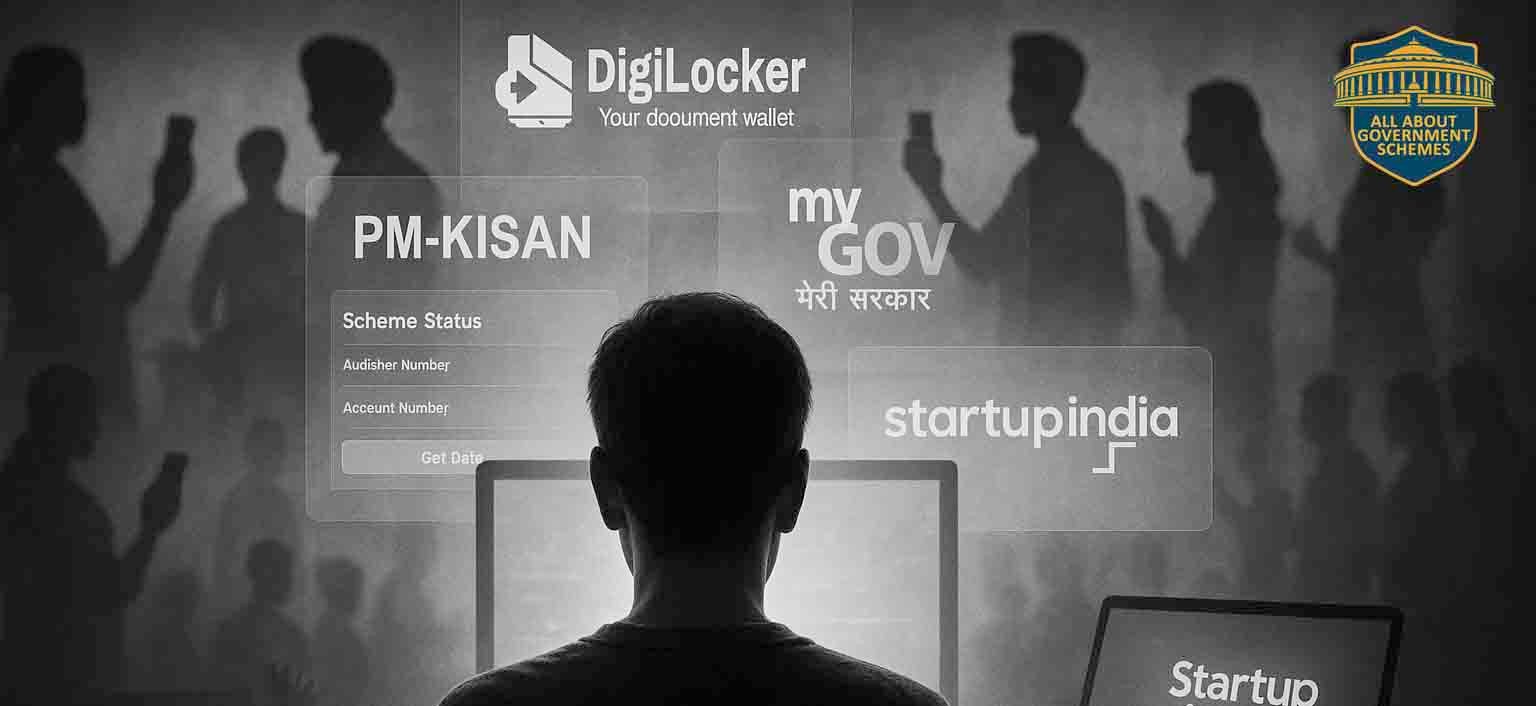
In today’s India, governance is no longer hidden behind files and offices — it lives on screens, in dashboards, and in the hands of everyday people. From a farmer checking PM-KISAN status on a smartphone to a student downloading certificates from DigiLocker, Digital Governance has quietly rewritten the relationship between the citizen and the state.
At All About Government Schemes, we make this new world of online access simpler, safer, and clearer. We bring you verified links, authentic portals, and step-by-step dashboards so that every citizen — rural or urban, young or senior — can claim what’s rightfully theirs with a single click.
Because good governance isn’t just digital — it’s understandable.
What Is Digital Governance?
Digital Governance (or e-Governance) means delivering government services electronically — using the internet, cloud platforms, and mobile applications.
It replaces queues, stamps, and signatures with portals, OTPs, and dashboards.
But more than technology, it represents trust through transparency — ensuring that every citizen can:
- Access information online.
- Apply for benefits without brokers.
- Track their applications in real time.
- Receive updates directly in their inbox or phone.
It’s governance without barriers — where data flows faster than paperwork.
Why Digital Governance Matters
India is home to over 850 million internet users. The next revolution isn’t industrial; it’s informational.
Digital Governance ensures:
| Benefit | Impact |
|---|---|
| Transparency | Citizens can see where every rupee goes. |
| Efficiency | Applications are processed faster, with fewer errors. |
| Accountability | Every transaction leaves a digital footprint. |
| Inclusion | Rural and remote citizens can access services online. |
| Environment | Less paper, less travel, smaller carbon footprint. |
India’s Flagship e-Governance Initiatives
🌐 1️⃣ Digital India Mission
Launched in 2015, the Digital India campaign aims to transform India into a digitally empowered society and knowledge economy.
It rests on three pillars:
- Digital Infrastructure as a Utility to every citizen.
- Governance & Services on Demand.
- Digital Empowerment of Citizens.
Under this, initiatives like DigiLocker, e-Sign, UMANG App, and BharatNet were created to connect every household and office online.
🗂️ 2️⃣ DigiLocker – Your Digital Document Vault
📱 3️⃣ UMANG (Unified Mobile App for New Governance)
Purpose: One app, all services.
Features: Over 2,500 services — from EPFO to PMAY — available in 13 languages.
Impact: Crosses 5 crore downloads, connecting central and state departments on a single citizen-centric interface.
💰 4️⃣ Public Financial Management System (PFMS)
Purpose: Real-time tracking of fund flow in government schemes.
Benefits:
🏛️ 5️⃣ MyGov Portal
Purpose: Citizen engagement and participatory governance.
Features: Online surveys, idea contests, feedback channels.
Impact: Over 3 crore registered citizens contributing directly to policymaking.
🌱 6️⃣ e-NAM (National Agriculture Market)
Purpose: A unified online marketplace for agricultural produce.
Impact: 1,000+ mandis, 1.7 crore farmers.
Result: Fair pricing, transparency, and nationwide access.
🧾 7️⃣ National Single Window System (NSWS)
Purpose: Simplify business approvals and licenses.
Users: MSMEs and startups.
Outcome: Reduced red tape; one-stop clearance portal for 31 central departments and 22 states.
🩺 8️⃣ Ayushman Bharat Digital Mission (ABDM)
Purpose: Build a digital health ecosystem with unique Health IDs for citizens.
Portal: https://healthid.ndhm.gov.in
Impact: Over 50 crore Health IDs generated.
Goal: Seamless access to medical records and hospitals.
Digital Empowerment at the Grassroots
In villages and small towns, Common Service Centres (CSCs) are bringing digital governance home.
Through over 6 lakh CSCs, citizens can:
- Apply for PAN, Passport, PM-KISAN, and pensions.
- Pay utility bills and property taxes.
- Access tele-law, tele-medicine, and e-education.
These centres are run by local entrepreneurs — the VLEs (Village Level Entrepreneurs) — turning rural India into a living network of smart service providers.
Bridging the Digital Divide
Digital Governance isn’t complete until it reaches the last citizen.
The government and private partners are working to close the gap through:
- BharatNet: Optical fibre to 2.5 lakh Gram Panchayats.
- PMGDISHA: Digital literacy for 6 crore rural households.
- Mobile First Design: Making government apps work on basic smartphones.
- Multi-language support: Portals in Hindi and regional languages.
Each click in a village is a silent revolution — a proof that inclusion is the truest innovation.
Our Role: Simplifying Digital Access
At All About Government Schemes, we help citizens navigate this digital ecosystem through:
✅ Verified Links: Only official .gov.in or .nic.in sources.
✅ Simplified Dashboards: Clean visual summaries for each portal.
✅ How-to Guides: Step-by-step instructions for registration and tracking.
✅ Security Tips: Avoiding phishing or fake portals.
✅ Grievance Help: Direct escalation emails and helplines.
We believe the true success of e-governance lies not in how advanced the technology is, but in how accessible it feels.
Real-World Stories
1️⃣ Rukmini Devi – Village Entrepreneur, Bihar
Using her local CSC, she helps villagers download PM-KISAN receipts and pension statements. “Earlier we travelled 40 km for a signature. Now, a printout from my centre does it.”
2️⃣ Imran Khan – Startup Founder, Delhi
Registered his firm through the NSWS portal in under a week. “Digital approvals made me believe that bureaucracy can be efficient.”
3️⃣ Shreya Das – Student, Assam
Used DigiLocker for her college admission. “No need for photocopies or attestation — just a QR code.”
These are not isolated successes — they are snapshots of a nation learning to trust its digital self.
Challenges Ahead
While the progress is inspiring, gaps remain:
- Connectivity: Last-mile internet in remote areas.
- Digital Literacy: Elderly and non-literate citizens need assistance.
- Data Security: Protecting citizen privacy and preventing fraud.
- Inter-Department Integration: Many portals still work in silos.
Overcoming these will require not only better networks but better awareness — the kind of awareness we spread every day.
The Future of Smart Governance
By 2030, India’s governance will be predictive, AI-driven, and voice-enabled.
Imagine:
- Asking a chatbot, “Am I eligible for any government scheme?” and getting instant results.
- Uploading land records once — reused automatically across departments.
- Biometric authentication for seamless service delivery.
Digital Governance 2.0 will not just be paperless — it will be effortless.
Our job is to ensure citizens arrive at that future informed and confident.
Conclusion
Smart India doesn’t happen in conferences or code — it happens in conversations between citizens and systems that listen.
Every verified link you click, every status you check, every online form you complete — it’s a small victory for transparency.
At All About Government Schemes, we make sure those victories are easy, safe, and universal.
“Because when access becomes simple, governance becomes powerful.”
DigitalIndia #eGovernance #SmartCitizen #PublicWelfare #OnlineServices #Transparency #DigitalAccess #InformedCitizen #InclusiveGrowth #GoodGovernance #AllAboutGovernmentSchemes