
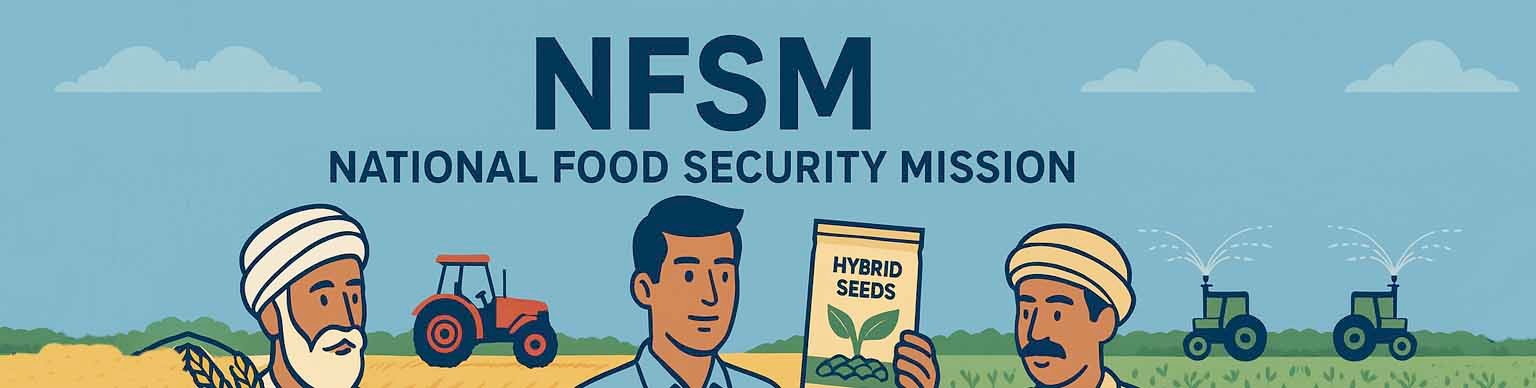
National Food Security Mission (NFSM)
Ministry: Ministry of Agriculture & Farmers Welfare, Government of India
Launched: October 2007
Implemented By: Department of Agriculture, Cooperation & Farmers Welfare (DAC&FW)
Scheme Type: Food Security & Crop Productivity Enhancement
Beneficiary Type: Farmers (especially small and marginal), FPOs, Cooperatives, and State Governments
Coverage: All States & Union Territories (based on crop potential)
Category: Agriculture & Food Security
Official Website: https://nfsm.gov.in
About the Scheme
The National Food Security Mission (NFSM) was launched in 2007 with the aim to increase the production of rice, wheat, pulses, coarse cereals, and commercial crops through area expansion, productivity improvement, and resource efficiency.
It plays a vital role in ensuring food and nutritional security for India’s growing population while promoting sustainable agricultural practices.
Goal: To achieve self-sufficiency in food grain production and ensure equitable distribution of resources to small and marginal farmers.
🧭 Objectives
- To increase production and productivity of major food crops (rice, wheat, pulses, coarse cereals, oilseeds).
- To restore soil fertility and nutrient balance through integrated nutrient management.
- To promote modern agricultural technologies like hybrid seeds, farm mechanization, and precision farming.
- To enhance farmer income through efficient resource use and improved cropping systems.
- To ensure sustainable food and nutritional security at the national and household level.
🧾 Key Features
- Focuses on district and crop-specific interventions.
- Promotes cluster-based demonstrations to showcase new technologies.
- Encourages hybrid seeds, mechanization, and micro-irrigation.
- Financial assistance for farm implements, water-saving devices, bio-fertilizers, and pest management.
- Sub-missions for targeted interventions (listed below).
- Monitoring through online portal: https://nfsm.gov.in
Eligibility Criteria
| Eligible Beneficiaries | Details |
|---|---|
| Individual farmers | Particularly small and marginal farmers cultivating eligible crops |
| FPOs / Cooperatives | Engaged in collective farming and seed distribution |
| State Governments | Implement district-level action plans |
| NGOs / Institutions | Can participate in demonstrations and awareness programs |
Priority Given To:
- Small & marginal farmers
- Women farmers
- SC/ST beneficiaries
- Farmers adopting new technologies
Documents Required
| Type | Document |
|---|---|
| Identity Proof | Aadhaar card / Voter ID |
| Land Record | Khatauni / Land ownership document |
| Bank Details | Passbook / Account number |
| Crop Details | Sowing declaration / Crop record |
| Photo | Passport-size photograph |
| Mobile Number | For updates and status alerts |
How to Apply
🖥️ Online Method
- Visit https://nfsm.gov.in
- Click on “Farmer Corner → Apply Online.”
- Select your State, District, and Crop Type.
- Fill in details (Aadhaar, land, bank, crop) and upload documents.
- Submit the form — you’ll receive a reference number for tracking.
Offline Method
- Visit the District Agriculture Office / Krishi Vigyan Kendra (KVK).
- Collect and fill out the NFSM application form.
- Attach all documents and submit to the Agricultural Officer.
- Field verification will be conducted before approval.
Funding Pattern
| Region | Centre’s Share | State’s Share |
|---|---|---|
| General States | 60% | 40% |
| North-Eastern & Hill States | 90% | 10% |
| Union Territories | 100% | — |
Financial Assistance (Indicative):
- ₹1,200/ha for hybrid seeds.
- 50% subsidy on farm machinery (tractors, seed drills, planters, etc.).
- ₹15,000/ha for demonstration of improved practices.
- 50% assistance for water-saving devices and micronutrients.
Funds are released to States under the Direct Benefit Transfer (DBT) mechanism for transparency.
📈 Achievements
- Foodgrain production increased from 234 million tonnes (2007–08) to over 330 million tonnes (2023–24).
- India became self-sufficient in rice and wheat production.
- Pulses production crossed 27 million tonnes, reducing imports.
- Increased mechanization and hybrid seed adoption nationwide.
- Contributed significantly to India’s food and nutritional security goals.
Benefits Summary
- Boosts national food production and security.
- Encourages climate-resilient, sustainable farming.
- Provides direct input subsidies and demonstrations.
- Enhances income and technology adoption among farmers.
- Reduces import dependency on pulses and cereals.
Contact Details
National Food Security Mission (NFSM) Division
Department of Agriculture, Cooperation & Farmers Welfare
Ministry of Agriculture & Farmers Welfare
Krishi Bhawan, Dr. Rajendra Prasad Road,
New Delhi – 110001
📞 Helpline: 1800-180-1551
🌐 https://nfsm.gov.in
How to Check Application / Scheme Status
- Visit https://nfsm.gov.in
- Click on “Beneficiary / Project Dashboard.”
- Select your State / District / Year.
- Enter your Application Number / Aadhaar.
- View your status, subsidy amount, and implementation progress.
Follow-Up & Grievance Redressal
If facing issues in receiving benefits or updates:
- Contact your District Agriculture Officer / NFSM Nodal Officer.
- Lodge grievances at https://pgportal.gov.in
- Call National Helpline: 📞 1800-180-1551
- Email: nfsm@agricoop.nic.in
Who’s Who
| Designation | Name | Role |
|---|---|---|
| Union Minister of Agriculture & Farmers Welfare | Shri Shivraj Singh Chouhan | Overall leadership of NFSM |
| Minister of State (Agriculture) | Shri Bhagirath Choudhary | Coordination with States |
| Secretary (Agriculture & Farmers Welfare) | Shri Devesh Chaturvedi, IAS | Policy implementation & monitoring |
| DG, ICAR / Secretary (DARE) | Dr. Himanshu Pathak | Technical guidance & evaluation |
| Mission Director (NFSM) | — | Scheme management & reporting |
FAQs
1. What crops are covered under NFSM?
Rice, wheat, pulses, coarse cereals (millets, maize), and select commercial crops.
2. Is the scheme only for small farmers?
Priority is given to small, marginal, and women farmers, but all eligible farmers can participate.
3. How do farmers benefit directly?
Through subsidized seeds, training, farm equipment, and demonstrations of improved practices.
4. What is the role of ICAR and KVKs?
They provide technical support, training, and demonstrations for farmers.
5. Is NFSM linked with food distribution under NFSA?
No, NFSM focuses on production, while NFSA (National Food Security Act) ensures distribution.