
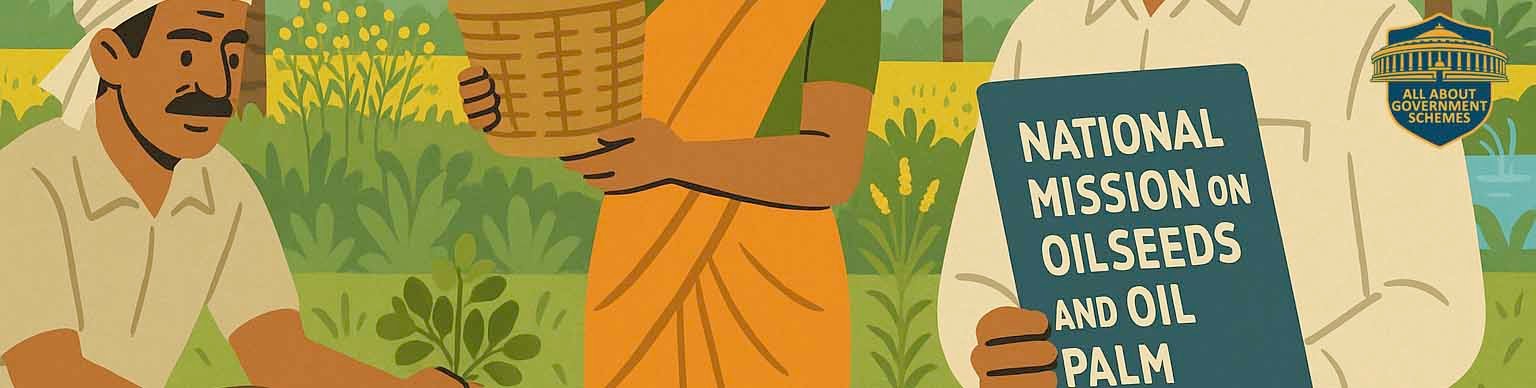
Ministry: Ministry of Agriculture & Farmers Welfare, Government of India
Launched: 2014–15 (12th Five Year Plan Period)
Implemented By: Department of Agriculture, Cooperation & Farmers Welfare (DAC&FW)
Scheme Type: Crop Diversification / Self-Reliance in Edible Oils
Beneficiary Type: Farmers cultivating oilseed and oil palm crops
Coverage: All States & Union Territories (with focus on oilseed-growing regions)
Category: Agriculture & Crop Productivity
Official Website:https://agricoop.gov.in
About the Scheme
The National Mission on Oilseeds and Oil Palm (NMOOP) was launched to enhance India’s domestic production of edible oils and reduce dependence on imports.
It focuses on increasing the productivity of oilseed crops, expanding oil palm cultivation, and improving processing infrastructure.
Goal: To achieve self-sufficiency in edible oil production by promoting oilseed cultivation, oil palm plantations, and tree-borne oilseeds (TBOs) through scientific techniques, quality seeds, and farmer support.
🧭 Objectives
- To increase production and productivity of oilseed crops and oil palm.
- To reduce India’s import dependence on edible oils.
- To expand oil palm cultivation area in suitable agro-climatic zones.
- To promote tree-borne oilseeds (TBOs) like neem, karanja, mahua, etc.
- To enhance availability of high-quality planting materials and inputs.
- To ensure efficient post-harvest processing and marketing infrastructure.
🧾 Key Features
- Three Mini-Missions under NMOOP:
- Mini Mission-I: Oilseeds (groundnut, soybean, mustard, sunflower, sesame, etc.)
- Mini Mission-II: Oil Palm (introduction and area expansion in NE & other states)
- Mini Mission-III: Tree-Borne Oilseeds (TBOs) like neem, mahua, karanja, and sal seed.
- Focus on cluster-based area expansion, improved varieties, and modern cultivation practices.
- Support for seed production, irrigation, plant protection, farm equipment, and training.
- Promotion of oil processing units and farmer cooperatives.
- Subsidy and assistance for seed distribution, irrigation, and maintenance of oil palm gardens.
- Integration with Rashtriya Krishi Vikas Yojana (RKVY) and National Food Security Mission (NFSM) for convergence.
Eligibility Criteria
| Eligible Beneficiaries | Details |
|---|---|
| Individual farmers | Growing oilseeds or oil palm in designated areas |
| FPOs / Cooperatives / SHGs | Engaged in oilseed cultivation or processing |
| Entrepreneurs / Processors | Eligible for post-harvest processing units |
| States / UTs | Implementing the mission through Agriculture Departments |
Not Eligible:
- Non-agricultural entities or lands unsuitable for oilseed cultivation.
Documents Required
| Type | Documents |
|---|---|
| Identity Proof | Aadhaar card / Voter ID |
| Land Ownership Proof | Land record / Khatauni |
| Bank Details | Passbook / Account number |
| Crop Proof | Sowing certificate or declaration |
| Mobile Number | For verification and status updates |
| Photo | Passport-sized (optional) |
How to Apply
🖥️ Online Method
- Visit your State Agriculture Department Portal or https://agricoop.gov.in
- Look for the NMOOP section under Schemes / Farmer Welfare.
- Click “Apply Online” and select your crop (Oilseed / Oil Palm / TBO).
- Fill in personal and land details, upload documents, and submit.
- The Agriculture Officer will verify and approve your registration.
- Subsidy or assistance is transferred through Direct Benefit Transfer (DBT).
🏢 Offline Method
- Visit the District Agriculture Office / Krishi Vigyan Kendra (KVK).
- Collect and fill the NMOOP application form.
- Attach land, crop, and bank details.
- Submit to the Agriculture Officer or State Nodal Officer.
- Field inspection will be conducted before approval.
Financial Assistance Pattern
| Component | Financial Assistance | Remarks |
|---|---|---|
| Seed production & distribution | 50% subsidy (max ₹1,200/ha) | Certified / HYV seeds |
| Integrated pest/nutrient management | 50% subsidy | As per crop |
| Farm implements & irrigation | 50% subsidy | Drip/sprinkler systems |
| Oil Palm area expansion | ₹1,20,000/ha over 5 years | Including planting material & maintenance |
| Tree-Borne Oilseeds (TBOs) | ₹50 per seedling | For nursery development |
| Training & capacity building | 100% assistance | Organized by State Departments |
Contact Details
Department of Agriculture, Cooperation & Farmers Welfare
Ministry of Agriculture & Farmers Welfare
Krishi Bhawan, Dr. Rajendra Prasad Road,
New Delhi – 110001
📞 Helpline: 1800-180-1551
🌐 https://agricoop.gov.in
How to Check Application / Subsidy Status
- Visit https://agricoop.gov.in
- Navigate to Schemes → NMOOP → Beneficiary Dashboard.
- Enter Aadhaar / Registration Number.
- View subsidy, status, and project details.
Follow-Up & Grievance Redressal
If facing issues with subsidy or project implementation:
- Contact your District Agriculture Officer / State Nodal Officer (Oilseeds).
- Lodge a grievance via https://pgportal.gov.in
- Call the Agriculture Helpline: 📞 1800-180-1551
- Email: nmoop@agricoop.nic.in
Who’s Who
| Designation | Name | Role |
|---|---|---|
| Union Minister of Agriculture & Farmers Welfare | Shri Shivraj Singh Chouhan | Overall mission leadership |
| Minister of State (Agriculture) | Shri Bhagirath Choudhary | Field-level coordination |
| Secretary (Agriculture & Farmers Welfare) | Shri Devesh Chaturvedi, IAS | Policy & administrative head |
| DG, ICAR / Secretary (DARE) | Dr. Himanshu Pathak | Technical advisory & R&D support |
| Mission Director (Oilseeds & Oil Palm) | — | Scheme monitoring & evaluation |
FAQs
1. What is the main objective of NMOOP?
To increase the production of oilseeds, expand oil palm cultivation, and achieve self-reliance in edible oils.
2. Which crops are covered under the oilseed component?
Groundnut, mustard, soybean, sunflower, sesame, linseed, niger, safflower, and castor.
3. How much subsidy is provided for oil palm cultivation?
Up to ₹1.2 lakh per hectare over 5 years.
4. Is there any training support?
Yes, 100% grant for farmer training and field demonstrations.
5. What is the difference between NMOOP and NMEO-OP?
NMEO-OP (2021) is a restructured version of NMOOP with a stronger focus on oil palm self-sufficiency and private sector participation.