Government documents are supposed to serve citizens.
But too often, they read like they’re written for another planet.
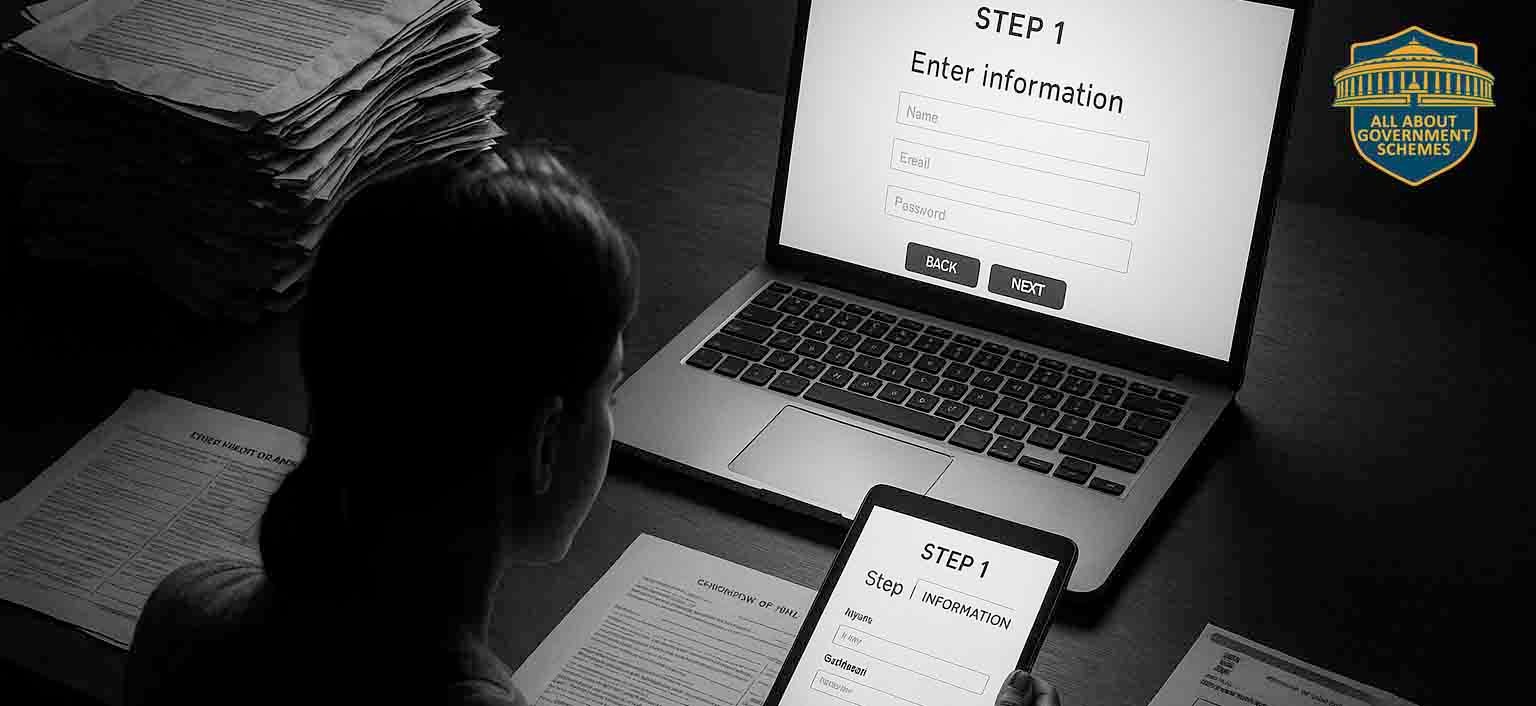
Dense paragraphs, outdated phrases, abbreviations no one explains — it’s no surprise that most people close the file before finishing the first page.
The result?
Citizens who are eligible for life-changing benefits never apply. Entrepreneurs skip subsidies. Students miss scholarships. Farmers lose claims. And all because a single form or circular was written in bureaucratic code.
At All About Government Schemes, we believe governance should speak human.
That’s why our mission is simple:
“No jargon. Just clarity.”
We decode government language — from complicated notifications and ministry guidelines to circulars and gazette releases — into clear, friendly, everyday explanations.
So that no Indian needs a lawyer, a babu, or a middleman to understand their own rights.
Why Bureaucratic Language Keeps Citizens Out
Bureaucracy evolved to maintain precision and legality — but over time, its language became a wall instead of a window.
Let’s look at what most citizens face:
- Legal Jargon: “Hereby”, “thereof”, “mutatis mutandis”… phrases that hide meaning instead of revealing it.
- Complex Eligibility Clauses: Long lists of conditions and sub-sections.
- Inconsistent Updates: A scheme revised five times without a clear summary of what changed.
- Scattered Sources: Notifications across multiple ministry portals, PDFs, and press releases.
When language intimidates, people withdraw.
When forms confuse, benefits are delayed.
When rules sound alien, trust in governance weakens.
Our Approach: Translating Policy Into Plain Language
At All About Government Schemes, our editorial process works like a translation desk — from bureaucratic to human.
Here’s how we decode each scheme:
1️⃣ We Read Everything So You Don’t Have To
Our research team dives into the original government PDFs, notifications, and annexures. We study the policy clauses line by line.
2️⃣ We Strip Away Red Tape
We identify what citizens actually need — who can apply, what documents are needed, how much benefit they’ll receive, and how to apply.
3️⃣ We Rewrite in Everyday Language
Then we rewrite each point clearly: short sentences, simple grammar, relatable examples.
4️⃣ We Add Visual Summaries
Each scheme includes infographics, checklists, and comparison charts — turning a 20-page document into a one-minute understanding.
5️⃣ We Verify & Update
Finally, everything goes through a two-level verification — with cross-checks from official sources and ministry updates.
The outcome?
An explanation that any student, farmer, homemaker, or entrepreneur can understand — without needing translation or interpretation.
The Power of Simplicity
Simplicity doesn’t mean dumbing things down.
It means making information usable.
When we simplify government documents, three powerful things happen:
- Citizens apply confidently.
They no longer fear making mistakes or missing deadlines. - Schemes reach intended beneficiaries.
Awareness converts into real participation. - Government communication improves.
Transparency grows when citizens can actually follow what’s written.
A simple example:
Original line in a government PDF:
“Beneficiaries possessing landholdings not exceeding two hectares are entitled to financial assistance in three equal instalments annually.”Our version:
“If you own less than 2 hectares of land, you’ll receive ₹6,000 a year in three parts — directly into your bank account.”
Same message. Different impact.
That’s the transformation we deliver every day.
Our Design Philosophy: Clarity Over Complexity
We designed our platform to be a visual learning space — where information feels light, intuitive, and conversational.
- Split-Screen Presentation:
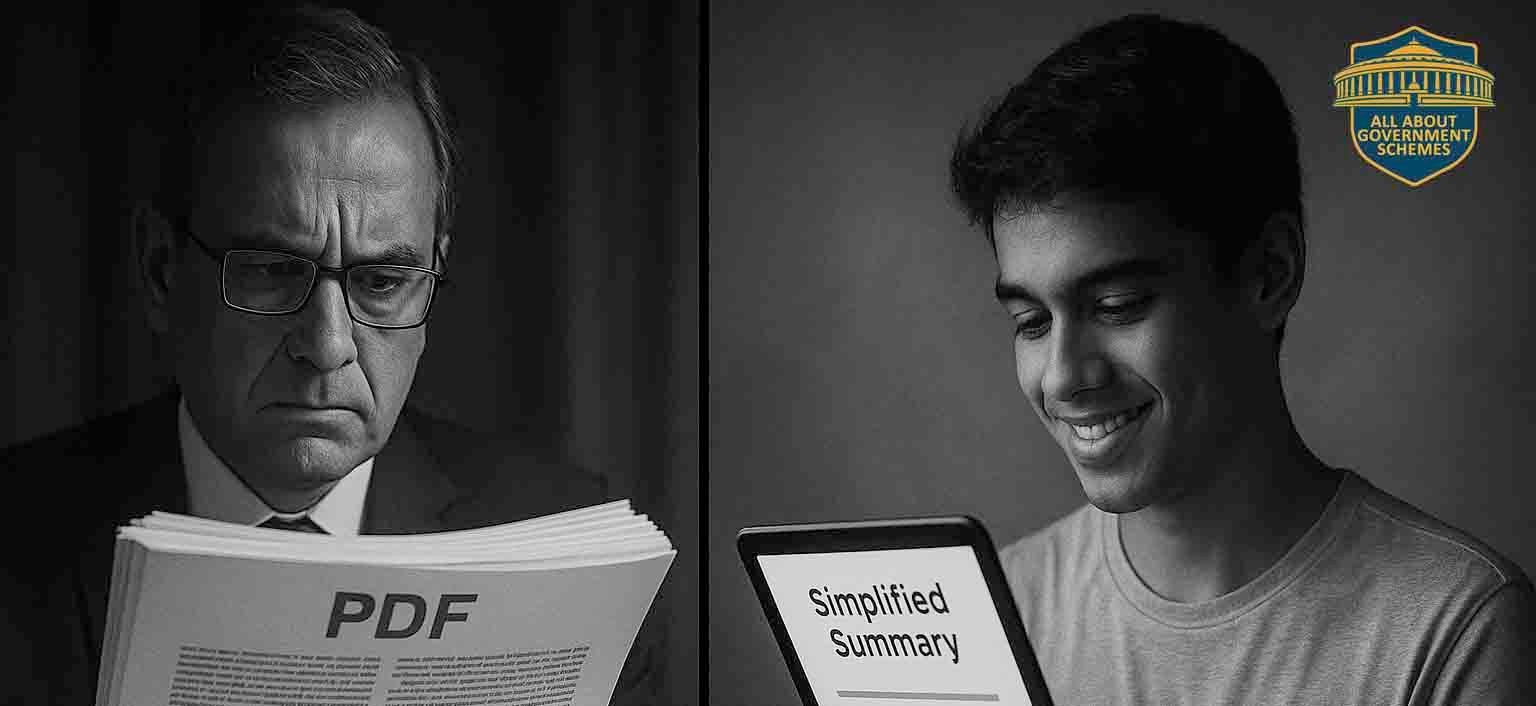
Each page shows an “Official PDF vs Simplified Summary” layout — allowing citizens to see how policy turns into plain talk. - Color-Coded Highlights:
Important keywords like Eligibility, Documents, Apply Online, Benefit Amount are highlighted for easy scanning. - Step-by-Step Diagrams:
Flowcharts for how to apply, where to submit forms, and how to track status. - Glossary Section:
We maintain a glossary that explains recurring bureaucratic terms — “Sanctioning Authority”, “Implementing Agency”, “Beneficiary Identification”, etc.
Our guiding question behind every post is:
“Would a first-time reader understand this without help?”
If not, we simplify further.
Examples of What We’ve Decoded
| Scheme | Bureaucratic Language | Citizen-Friendly Rewrite |
|---|---|---|
| PM-KISAN Samman Nidhi | “Financial assistance to eligible landholding farmer families subject to exclusion criteria as per guidelines.” | “Every small or marginal farmer family owning land gets ₹6,000 yearly — unless they’re income-tax payers or government employees.” |
| Ayushman Bharat | “Entitlement-based health coverage under NHPM with empanelled institutions.” | “Free treatment up to ₹5 lakh per family each year at listed hospitals across India.” |
| Samarth (Skill Development) | “Capacity building interventions for textile sector stakeholders.” | “Free training programs for textile workers, weavers, and artisans to upgrade their skills.” |
Why This Matters
Decoding bureaucracy is not just about simplifying documents — it’s about restoring trust.
When citizens finally understand what’s written in their name, they feel included in governance.
They stop depending on intermediaries.
They make informed decisions.
And when information becomes a right, not a privilege — the entire system becomes stronger.
Our clarity-driven approach aligns directly with:
- Digital India’s goal of transparency and inclusion.
- Good Governance initiatives promoting citizen-centric policy.
- SDG 16 (Peace, Justice & Strong Institutions) by fostering open communication.
Challenges We Face
Simplifying bureaucracy isn’t easy.
Each ministry has its own writing style, abbreviations, and templates. Circulars are updated frequently, and translations are often inconsistent.
Our editorial team spends hours comparing PDFs, tracing amendments, and ensuring that every line reflects the latest official version.
We treat simplification as a responsibility — because accuracy cannot be compromised for speed.
How Citizens Benefit
- Time Saved:
Instead of reading 50 pages, you get a one-page summary. - Confidence Gained:
No fear of misunderstanding terms or missing eligibility. - Direct Access:
Links lead only to official portals — no middle agents or unofficial sites. - Transparency Achieved:
Every claim is sourced. Every process is shown step by step.
Beyond Text: Accessibility for All
India is multilingual — and literacy levels vary widely. That’s why we also decode bureaucracy visually and vocally:
- Infographics: For quick summaries.
- Audio explainers: For citizens who prefer listening in regional languages.
- Videos: Showing how to fill forms or apply online.
- Icons & Symbols: For universal understanding — whether someone speaks Hindi, Tamil, or Assamese.
Our goal is not just to translate — but to humanize governance.
Our Broader Impact
Decoding bureaucracy has ripple effects:
- Governments communicate better. Ministries can use simplified templates for outreach.
- Citizens engage more. They read, share, and act.
- Awareness spreads. Villages learn from one another.
- Transparency grows. Misinformation loses ground.
In short, clarity creates confidence — and confidence fuels participation.
The Philosophy Behind “Citizen First”
Every article, visual, or guide we produce passes one test:
“Does this help a citizen take real action?”
We’re not here to impress with technical terms; we’re here to empower.
Our editorial voice is friendly, factual, and inclusive — because we write for the people, not for the paperwork.
This “Citizen First” philosophy drives everything — from layout design to language tone.
Looking Ahead
In the next phase, we’re developing:
- An AI-powered “Scheme Decoder” — upload any official PDF, and get a simplified explanation instantly.
- Glossary integration with tooltips on every post.
- Citizen feedback buttons — so users can suggest where clarity is still needed.
- Collaborations with ministries to co-create citizen-friendly communication templates.
By 2030, we aim to make All About Government Schemes the national reference hub for simplified public information.
Conclusion
Decoding bureaucracy is not just a service — it’s a form of empowerment.
When information becomes accessible, democracy becomes stronger.
Our promise to every citizen is simple:
“We read the fine print — so you can understand the bigger picture.”
No jargon. No confusion.
Just clarity, confidence, and connection between people and policy.
EaseOfUnderstanding #CitizenFirst #Transparency #DigitalIndia #GovernanceSimplified #PublicAwareness #GoodGovernance #EmpowerIndia #AccessibleInformation #InformedCitizen